The Rota Vicentina is a network of roughly 750 km of marked walking trails in the far southwest of Portugal, threading through the Parque Natural do Sudoeste Alentejano e Costa Vicentina, one of the wildest protected coastlines left in Europe. It is really three things in one: the Caminho Histórico (Historical Way), an inland rural route of about 230 km; the Trilho dos Pescadores (Fishermen's Trail), around 226 km of dramatic coastal footpath along cliffs and beaches; and a family of circular routes designed for day walks from the villages. Together they form one of the great long distance walking destinations in Europe.
We write this as hosts, not as visiting journalists. Our home, Raízes Vicentinas, sits among olive trees just outside Odeceixe in the Aljezur municipality, with the Trilho dos Pescadores passing 2 km from our door and the Caminho Histórico 6 km away. We are an official Rota Vicentina partner, we walk these paths in every season, and we spend a good part of our year helping guests plan stages, pack the right gear and time their trips well. This guide gathers everything we tell them, from choosing between the two main routes to luggage logistics and where to sleep.
One network, three ways to walk it
People often talk about "walking the Rota Vicentina" as if it were a single line on a map, but it is better to picture a web. Two long distance routes run roughly parallel from north to south, one inland and one on the coast, linked in many places and complemented by circular routes that loop out from towns and villages. You can commit to a two week thru-hike, string together three or four favourite stages, or simply pick a different day loop each morning from a fixed base. All three approaches are legitimate, and all three are wonderful.
Caminho Histórico (Historical Way)
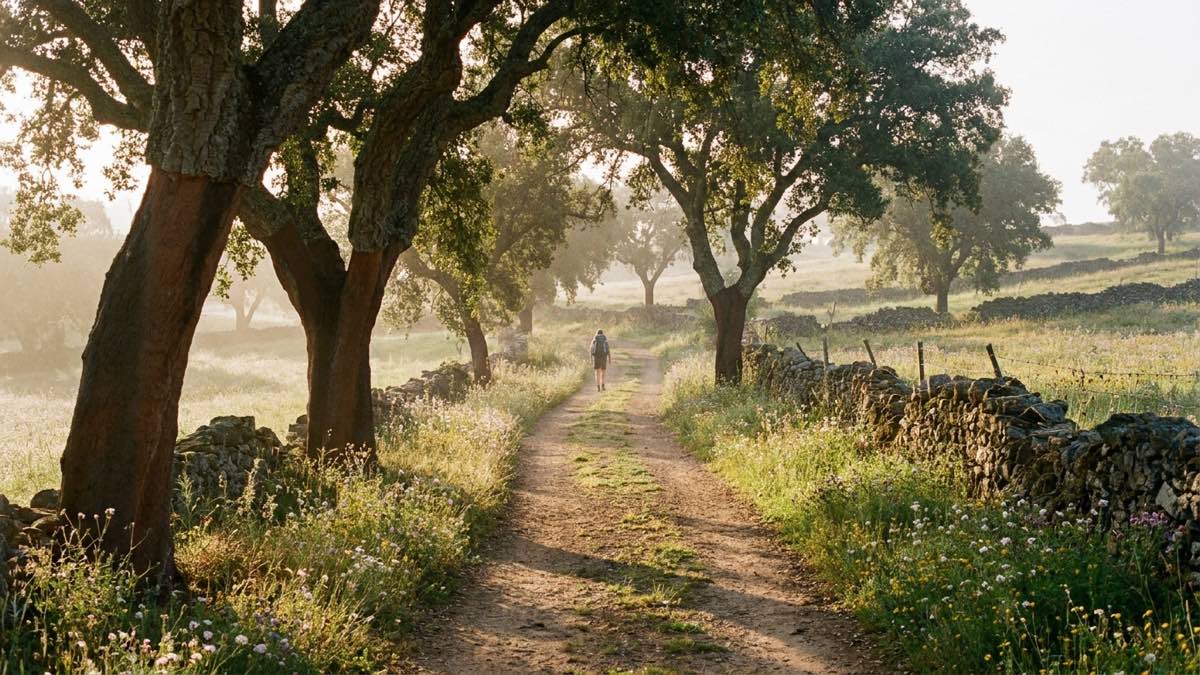
The Caminho Histórico is the inland spine of the network, about 230 km running from Santiago do Cacém in the north down to Cabo de São Vicente, the dramatic lighthouse cape at Europe's southwestern tip. It follows old rural paths and country lanes through cork oak woodland, eucalyptus, farmland, river valleys and quiet whitewashed villages, the working Alentejo and Algarve countryside that most beach visitors never see. This is the contemplative, pilgrim flavoured side of the Rota Vicentina, and its waymarks are the classic red and white stripes of European long distance paths.
Because it uses wider tracks and gentler gradients than the coastal route, the Caminho Histórico is also the branch that welcomes mountain bikes. If you prefer two wheels to two feet, or want to mix walking days with cycling days, this is where you do it. The route passes 6 km from our house, close enough that guests regularly walk or ride a section of it as a day out, then come home to a hot shower and a quiet evening among the olive trees.
Trilho dos Pescadores (Fishermen's Trail)
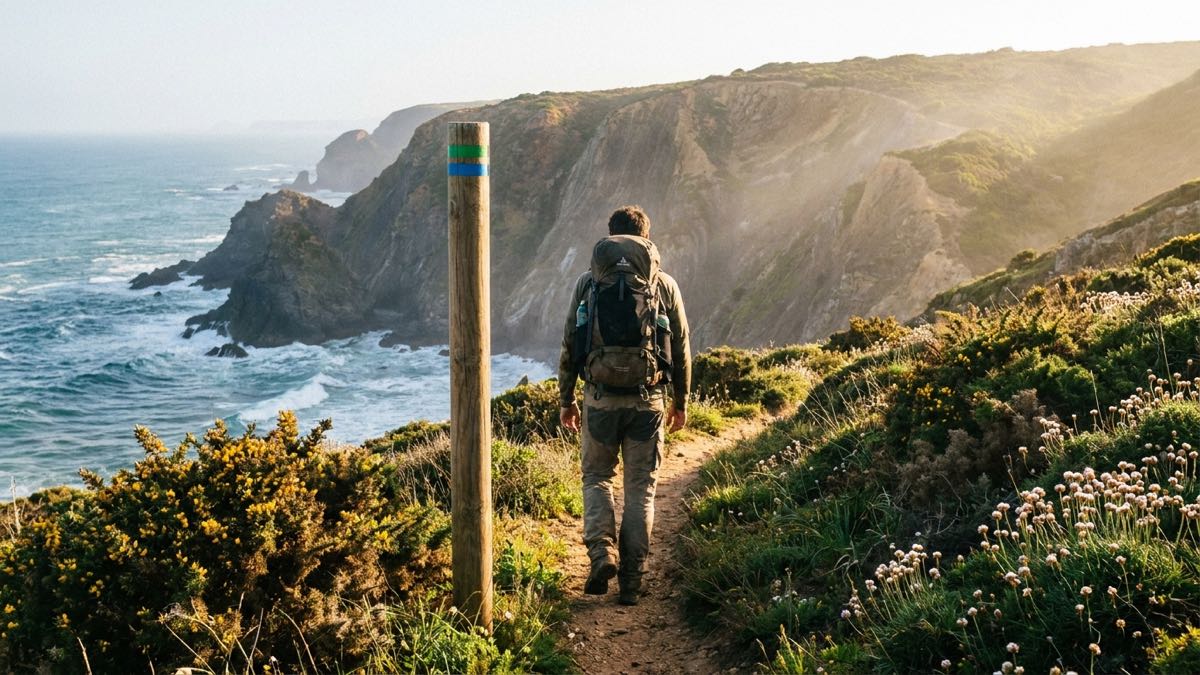
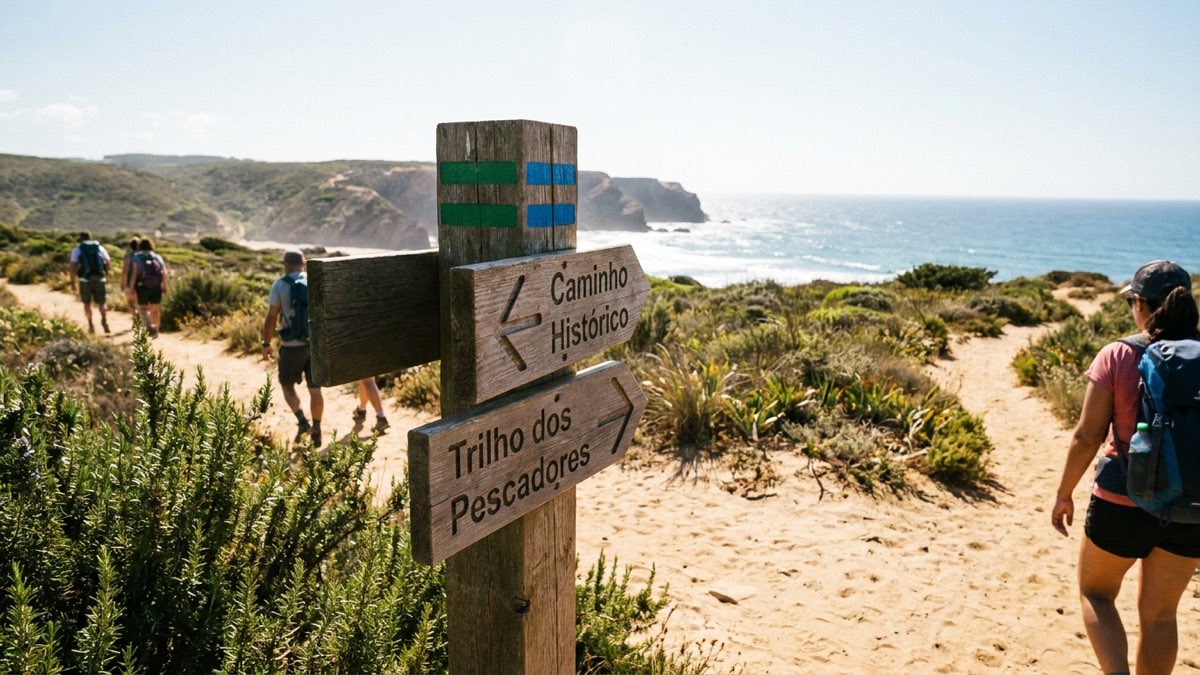
The Trilho dos Pescadores is the famous one, the route you have probably seen in photographs: around 226 km of coastal footpath tracing the very edge of the continent, from the Alentejo down along the Costa Vicentina. It follows the narrow paths that local fishermen have always used to reach their fishing spots on the rocks below, which means it clings to clifftops, dips into hidden coves, crosses dunes and beaches, and rarely strays out of sight of the Atlantic. The waymarks here are green and blue stripes, and the rule is strict: foot traffic only, no bikes.
It is also, and we say this with love, hard work. A large share of the walking is on sand, from soft dune paths to full beach crossings, and sand is a merciless multiplier of effort. Fifteen kilometres on the Trilho dos Pescadores can feel like twenty five on firm ground. The reward is scenery that genuinely does not let up: sea stacks, nesting storks, wild beaches with nobody on them, and that huge Atlantic light. Most walkers finish their first stage tired, salty and completely converted.
Circular routes: the day walker's secret
The third strand of the network is the collection of circular routes, signed loops that start and finish in the same village and typically take between a couple of hours and a full day. They are perfect if you want a taste of the Rota Vicentina without committing to point to point logistics: no luggage question, no transport shuffle, just park, walk and return. Several loops explore the countryside and coastline around Aljezur and Odeceixe, so guests staying with us can walk a different circle each day and still be home for dinner. They also make superb rest day options between longer stages.
Historical Way or Fishermen's Trail: which one is for you?
This is the question we are asked most often, and the honest answer starts with your legs and your priorities. The Fishermen's Trail gives you the postcard coastline all day, every day, but demands more effort per kilometre: soft sand, repeated short climbs in and out of coves, exposure to sun and wind, and narrow paths that require attention near the cliff edges. The Historical Way offers steadier walking on firmer tracks, more shade, more villages en route, and a quieter, more rural mood, at the price of seeing the ocean only occasionally.
Crowds differ too. The Trilho dos Pescadores has become internationally famous, so in spring and autumn you will meet a steady, friendly procession of walkers, and beds along the coastal stages book out well ahead. The Caminho Histórico remains much quieter; there are days when you will share it only with storks, sheep and the occasional farmer. If solitude ranks high for you, the inland route or the winter months are your friends. If sociable trail culture appeals, the coastal path in May or October is a delight.
As a rough guide from years of watching guests come home at dusk:
- Choose the Trilho dos Pescadores if coastal scenery is the whole point, you are reasonably fit, and you do not mind sand in your shoes as the fee for the best cliff views in Iberia.
- Choose the Caminho Histórico if you prefer gentler terrain, shade and villages, want to ride sections by mountain bike, or are walking in the warmer months.
- Mix the two if you have a week or more: the links between routes let you zigzag, taking the coast where it is most spectacular and the inland way where it is most charming.
Whichever you choose, do not treat the decision as final. The network is connected enough that you can change your mind mid trip. Many of our guests plan a coastal itinerary, discover what sand does to their calves by day three, and happily swap one stage for an inland or circular alternative. If you are leaning coastal, our detailed guide on where to stay on the Fishermen's Trail walks through the accommodation question stage by stage, which is usually the piece that makes or breaks the plan.
The best stages around Odeceixe and Aljezur
We are biased, of course, but we are far from alone in thinking that the stages around Odeceixe and Aljezur are the emotional high point of the whole Fishermen's Trail. This is where the Alentejo hands over to the Algarve, where the cliffs are at their most sculpted, and where the trail keeps delivering one improbable viewpoint after another. Three stages in particular deserve a place in any itinerary.
Zambujeira do Mar to Odeceixe
Many seasoned walkers call this the single finest day on the trail, and we would not argue. From the clifftop village of Zambujeira do Mar the path runs south along a coastline of dark sculpted rock, dropping into quiet coves and climbing back to headlands where storks nest on sea stacks just offshore. The finale is unforgettable: the trail swings around the mouth of the river to reveal Praia de Odeceixe, a broad crescent of sand held between cliffs and river. From the beach it is a gentle walk inland to Odeceixe village, and just a few kilometres to our door.
Odeceixe to Aljezur
This stage begins with the river and beach at Odeceixe and then alternates between wild clifftop and fragrant coastal scrub, with long views south down the coast you are about to walk. It passes close to Praia da Amoreira, one of the loveliest river mouth beaches anywhere on this coast, before turning inland to reach Aljezur, a whitewashed town stacked beneath the ruins of a Moorish castle. Because the stage starts practically at our doorstep, guests often walk it straight from the house, and we collect them in Aljezur at the end of the day.
Aljezur to Arrifana
South of Aljezur the trail returns to the ocean and heads for the surf country of the western Algarve. The walking passes the dunes and beaches around Monte Clérigo before climbing to the dark headland of Arrifana, where a small fishing harbour shelters beneath tall cliffs and surfers trace lines across one of the region's most consistent waves. Watching the evening light from the clifftop above Arrifana, with the whole coast you have walked stretched out to the north, is one of those moments that quietly justifies the entire trip.
When to walk the Rota Vicentina
Spring and autumn are the golden seasons, and it is not close. From March to May the clifftops erupt in wildflowers, temperatures sit in that ideal walking band where you are warm on the move and comfortable at rest, and the light is astonishing. From late September through November you get the mirror image: golden landscapes, a sea still warm from summer, and trails that empty out week by week. These are the months when the sand feels manageable, the water fountains of enthusiasm are justified, and every stage ends with energy left over for dinner.
Summer is possible but demands respect. July and August bring real heat, very little shade on the coastal route, and long stretches of soft sand that radiate warmth back at you. If you do walk in high summer, start at first light, carry more water than feels reasonable, plan a swim stop at a beach mid stage, and be finished by early afternoon. Winter, for its part, is mild and beautifully empty, with green hills and dramatic skies, but you will need to plan around rain, shorter days and some seasonal closures. For a month by month breakdown of weather, crowds and prices, see our guide to the best time to visit Costa Vicentina.
Preparing well: gear, water and waymarks
The Rota Vicentina is well organised and well marked, but it is still a wild coast, and the walkers who struggle are almost always the ones who underestimated the sand or the sun. Stages typically run between 15 and 25 km, which on this terrain means five to eight hours of walking. There is often no café, no shop and no shade between villages, so each stage needs to be treated as self sufficient. None of this requires expedition gear; it requires a little discipline in the packing.
Here is the checklist we hand our hiking guests:
- Broken-in footwear with good grip: trail shoes or light boots that have already done real kilometres, because sand plus rocky sections is a brutal test for new shoes.
- Water, at least 1.5 to 2 litres per person per stage, and more in warm weather; refill at every opportunity.
- Serious sun protection: hat, sunglasses and high factor cream, since the coastal route offers almost no shade and the Atlantic breeze disguises how strongly the sun bites.
- A windproof layer year round; the same breeze that cools you at noon can chill you on an exposed headland at five o'clock.
- Trekking poles if you like them: they genuinely help on soft dune descents and the repeated short climbs in and out of coves.
- Snacks, a fully charged phone, and a paper or offline map as backup.
Navigation is refreshingly simple. The Trilho dos Pescadores is waymarked with green and blue stripes, the Caminho Histórico with red and white, painted on posts, rocks and fences at every junction. Two parallel stripes mean continue, an arrowed pair signals a turn, and a cross means wrong way. The marking is frequent and well maintained, so with modest attention you will rarely be in doubt. For official route information, updated stage descriptions and GPS tracks, the trail association's own site at rotavicentina.com is the definitive source and well worth a look before you commit to dates.
Logistics: luggage, transfers and getting to the trail
The pleasant surprise for many first timers is how civilised the logistics can be. Because the Rota Vicentina passes through villages rather than true wilderness, you sleep in real beds, eat real dinners and can have your luggage moved for you. Luggage transfer services operate along the network, carrying your main bag from one night's accommodation to the next so that you walk each stage with only a light daypack. For anyone with shoulder issues, or anyone who simply prefers walking to hauling, this one arrangement transforms the entire experience.
Getting to and from the region, and between stage points, is the other half of the puzzle, since this quiet coast has limited public transport. This is where we can help directly: our private Tesla transfers run door to door from Faro airport (150 EUR, about 1h30) and Lisbon (250 EUR, about 3 hours), with real time flight tracking so a delayed arrival never strands you. For guests staying with us, we can also drop you at the start of a stage in the morning and collect you at the far end in the afternoon, which turns point to point stages into easy day trips from a single comfortable base. Details are on our transfers page.
That base camp approach deserves a word of its own, because it suits far more walkers than the classic village to village thru-hike. Staying put means no daily packing, no luggage timing, no gamble on the next night's bed, and the freedom to shuffle stages around the weather. With the coastal trail 2 km away and the inland route 6 km away, we sit at a natural crossroads of the network. Several guests have walked four or five of the region's best stages in a week without ever changing rooms, and if you like that idea, our 7 day Costa Vicentina itinerary shows how the pieces fit together.
Sleeping on the trail: our corner of the coast
Where you sleep shapes how the whole walk feels, and the Odeceixe area is one of the natural resting points of the entire route: the end of the celebrated Zambujeira do Mar stage, the start of the walk to Aljezur, and a village with real life in it rather than just trail services. Our house, Raízes Vicentinas, sits just outside the village among the olive trees, close enough to the Trilho dos Pescadores that you can be on the coastal path within half an hour of your morning coffee, and quiet enough that the loudest thing at night is the wind in the branches.
As an official Rota Vicentina partner, hosting walkers is not a sideline for us; it is a large part of why we opened. We offer three self contained units: Casa T3 for up to six people, ideal for a group of friends walking together, the Loft for four, and Casa T1 for two, all with views over the olive trees and a shared pool arriving in phase 2, from July 2026. Free bikes are available for every guest, handy for rolling down to the village for dinner or exploring the Caminho Histórico on a rest day. And because we walk these stages ourselves, you get route advice with your breakfast.
Praia de Odeceixe is 5 km from the house, Aljezur 12 km, Zambujeira do Mar 16 km, and the beaches of Amoreira, Monte Clérigo and Arrifana all within about 23 km, so rest days want for nothing. Whether you are passing through for one night mid thru-hike or settling in for a week of day stages, you will find drying space for boots, honest advice about tomorrow's terrain, and hosts who genuinely want to hear how the storks looked from the clifftop.
Walking gently: respect for the natural park
Everything described in this guide exists because this coast is protected. The Parque Natural do Sudoeste Alentejano e Costa Vicentina shields one of Europe's last long stretches of undeveloped Atlantic shoreline, and the Rota Vicentina works only as long as walkers tread lightly. The rules are few and reasonable: stay on the marked trails, since the clifftop vegetation that looks so tough is actually fragile and slow to recover; pick nothing, however tempting the wildflowers; and carry every scrap of your litter to the next village bin, including fruit peel.
Two points deserve special emphasis. First, the white storks that nest on the sea cliffs and stacks here are a rarity, one of the few places in the world where the species breeds on coastal rock, so admire them from the path and give nesting sites generous distance, especially in spring. Second, drones are not permitted over the park without proper authorisation, however tempting the aerial shot may be. Walk quietly, close gates behind you, buy your bread and dinners in the villages, and you become exactly the kind of visitor this landscape needs: one who leaves money in the communities and nothing on the trail.
That, in the end, is the deal the Rota Vicentina offers. It gives you weeks of the most beautiful coastal and rural walking in Europe, marked, organised and welcoming; in return it asks for sensible shoes, enough water and a light footprint. Take the deal. And if your plans bring you along the cliffs between Zambujeira do Mar and Arrifana, our door, our bikes and our best trail advice are 2 km from the path. Any questions before you book, from stage choices to boot drying, our FAQ covers the practical details, and we answer everything else by email within a day.